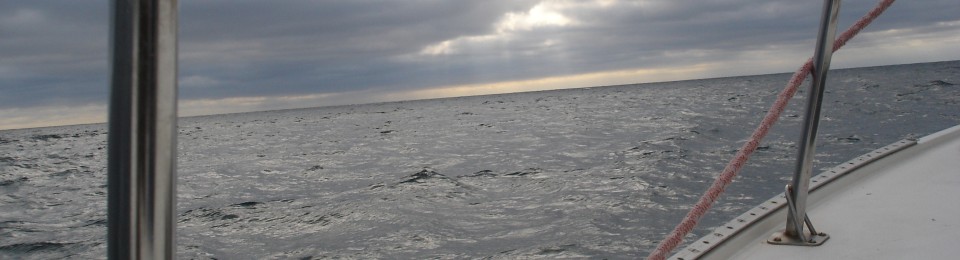
When out the other day. A high barometer means minimal wind hereabouts. If lucky the late afternoon might bring 7 knots. A calm sail was just fine with me. It would suit my mood. A laid back, soaking sun type day.
So I was a bit surprised around 3 PM when she heeled over. Hmmm, best de-power the sails somewhat. So reaching for the out haul I yanked. Nothing moved. Then I put my weight into it with them same result. Funny, there is never a big strong woman around when you need one.
Thinks I, it is time to upgrade that old out haul tackle. Back at dock I took a good look at it. 4 to 1 purchase and a million percent friction. Not cool. It’s a car in a groove arrangement: clew ring on one end with a built in sheave on the other. The line attaches to one side near end of boom, runs to the car’s sheave, then to the other side of the boom to a turning block, then forward to a cleat. Line rubs the boom. Friction so high it might as well be glued.
Now I’m one of those research-to-death project guys. So found all sort of opinions of what to rig from 5 to 1 on up. Inside the boom is popular, it is the rage for the production boat crowd. The more power the more blocks. The more blocks the more friction. The more complexity the more cost and effort.
Anyway it was clear the old 4 to 1 was too weak.
So armed with raw data I started to design the rig. No less than 13 configurations I meticulously drew calculating net power. Finally settling on a 9 to 1, with 4 single blocks and the existing turning block. Maybe $100.00. I liked the cost.
The design called for cascading two sets of 2 blocks each set rove to advantage. Each set has a 3 to 1 advantage, cascading multiplies, so 9 to 1 overall. Cool, but wait there is friction. Some say 5% lost per block, others say 10%. Feeling optimistic with 4 blocks and 1 turning block it’s looking like 6.75 to 1 net power gain. Good enough for 15 knots I hope.
How much line to use? Cascades take a fair amount of line. Following the adage measure twice cut once a prototype seemed to be a good idea. So while waiting for the blocks to arrive I set about stringing a prototype together.
Just need enough line to move the car between the painted limit lines on the boom. Just need to keep the car between them. Too bad they never existed on this boom. More research came up with a sail depth or belly of 15% of sail’s foot maximum. So holding sail out from boom that amount defines the loose side and of course stretched defines the tight side.
Surprise, 12 feet of line?
The car travels less than a foot. Yet it needs 12 feet to rig it. Measured 3 times to be sure. It took 3 hours to prototype and mark the limit lines. Well there was some chit-chat going on with the neighbors. Quite a pleasant time.
The blocks finally arrived. Two with just a shackle and two with a shackle and becket.
Rigging went easy right up to the point of cleating the bitter end. It reached the cleat – barely. Bad words followed. Then to chandler. Line was short a foot, so got that one plus another foot.
Rigging went easy right up to the point of the first test. What the? It doesn’t reach the tightest position? What? What?
Ahh, couldn’t shackle the block to the car so connected it to the sail’s clew ring. So the car isn’t pulled aft; it floats forward an inch or so. How special.
Option 1: move the limit lines – glad I waited to paint them, used tape. Maybe I should change that to glow-in-dark tape. I like that.
Option 2: Incorporate the car sheave so it will pull the car back. Oh my. That will increase power to 12 to 1, netting 8.4 to 1! I like that even more.
Thirteen designs on paper just doesn’t compare to reality.
Bet you’re dying to know what rove to advantage is? The line’s end can be attached to the fixed or mobile block of the tackle, the one that’s moving the load. On the mobile block it adds power, hence rove to advantage. Power ratio is simply the number of lines touching the mobile block. For this out haul, roving to advantage doubled the power overall.
Cascades are equally simple. Just tie the 2nd set’s mobile block to the line you’d pull on the 1st set. It multiples power at the cost of lots of line. Fewer blocks needed at the cost of lots of line. Lots of line means lots of easy pulling.

